
Greek And Roman Deities On Coins-25
2026-02-10 Tue
In #ancient #Greek religion, the twelve Olympians are the main deities of the Greek pantheon, including Hephaestus. Hephaestus, also known as Hephaistos, is honored as the Greek god of artisans, blacksmiths, carpenters, craftsmen, #fire, metallurgy, metalworking, #sculpture, and volcanoes. He is recognized as the master blacksmith of the Olympian gods, creating impressive structures, #armor, and clever devices for them. Notably, he is the only deformed god among the otherwise flawless Olympians. In #Roman tradition, he is linked to Vulcan.According to various #Legends, Hephaestus is either the child of both #Zeus and #Hera or solely of Hera. In both versions, Hera was upset by Hephaestus' appearance and threw him from #mount Olympus down to #Earth. He landed on the #Island of Lemnos, in the northern Aegean Sea, where he suffered permanent injuries. Taken care of by sea nymph Thetis, Hephaestus built his #workshop inside the island's volcano, living in an unbreakable #Bronze #House where he made remarkable metalwork. Eventually, Hephaestus sought #revenge on Hera for her rejection by creating a #magical throne that pinned her in place when she sat down. Although the other gods begged him to return to Mount Olympus to free her, he initially refused. In the end, Dionysus convinced him to go back, and Hephaestus agreed to release Hera after being promised #marriage to #Aphrodite.
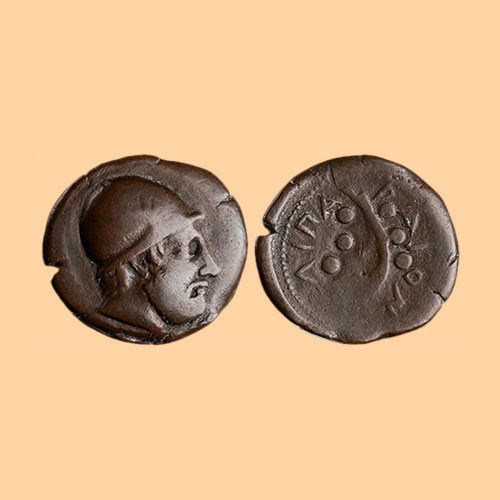
In Greek art, Hephaestus is often shown as a #bearded man holding a hammer and tongs. He typically wears a pilos, a protective cap worn by smiths, and a chiton, a tunic common in ancient #Greece and #Rome. His #Image first appeared on coins in the 4th century BCE. The #COIN featured in this post is a Bronze coin from Lipara, dating between 350 BCE and 309 BCE. Lipara is an ancient Greek city-state and island off the northern coast of Sicily in Southern #Italy. With a dia of 39 mm and a weight of 40.66 grams, the obverse features a head of Hephaestus facing right, adorned with a pilos. The reverse displays an aphlaston, the upward-curving stern of an ancient warship, flanked by three pellets on each side, along with the Greek inscription ‘LIPARAION,’ which means ‘Lipara.’
Latest News
-
The Elephant on an Indo-Greek Silver Drachm of Apollodotus I
2026-09-22 TueElephants were not just an important part of Indian heritage and religious traditions; they also ...
-
Gajalakshmi Flanked by Elephants on a Post-Mauryan Ujjaini Copper Coin
2026-09-22 TueThe association between Gajalakshmi and elephants is one of the most enduring motifs in Indian re...
-
Elephant Head on a Bronze Coin of Indo-Scythian King Maues
2026-09-21 MonAs the eighth day of Ganesh Utsav is celebrated, the elephant once again provides a fascinating l...
-
A Remarkable Elephant-and-Lion Standard on Vrishni Coinage
2026-09-21 MonAs Ganesh Utsav continues, the elephant once again offers a fascinating doorway into India’s an...
-
Elephant and Lion on a Cooch Behar Royal Coin
2026-09-19 SatThe elephant occupies a distinctive place in the cultural traditions of eastern India, particular...